Mutrah Souq is famous — but it’s also easy to rush through it without really understanding how it works.
A walk through this fascinating market reveals objects with stories and a long, thrilling history of trade. Join me as we explore it…
If you’re short on time, these quick answers give you an overview before diving into the details below.
What is Mutrah Souq, and why is it historically important?
Mutrah Souq is one of Oman’s oldest working markets, historically linked to Muscat’s harbour and centuries of Indian Ocean trade. Long before roads and the Corniche existed, goods arrived here by boat and camel, making the souq a key meeting point between Oman, India, Iran, and East Africa. This is WHY it is often described as ‘iconic.’
Where is Mutrah Souq, and how do you enter it?
Mutrah Souq sits directly on the Mutrah Corniche, opposite the sea, just west of central Muscat. Most visitors enter through the large arched gateway on the Corniche, but the market also connects to surrounding the neighbourhood through smaller back entrances that reveal a much more ‘local feel’ to the souq.
What is genuinely worth buying at Mutrah Souq?
Mutrah Souq is best for products that reflect long-standing trade and everyday use: frankincense from Dhofar, whole spices, traditional textiles, and silver items. These are not produced to be ‘souvenirs’ — they are goods still used in Omani homes and ceremonies, which gives them cultural meaning beyond decoration.
Mutrah Souq is usually open twice daily:
Day | Morning Session | Afternoon/Evening Session |
|---|---|---|
Saturday to Thursday | 8:00 AM – 1:00 PM | 4:00 PM – 10:00 PM |
Friday | Closed (Morning Prayers) | 4:00 PM – 10:00 PM |
For most visitors, the late afternoon or early evening is the best time to go, when temperatures are cooler and both locals and visitors are present. The period before major festivals can be especially active.
Mutrah Souq is often described as ‘iconic’, a word that appears in almost every guide. Yet, to truly understand what’s happening inside the market, it requires going beyond the busiest alleys and most familiar stalls.
This guide offers a step-by-step route through the souq, helping you to really experience what you encounter — and get a sense of what’s worth buying beyond ‘souvenirs’ or gadgets.
Most people enter into the Souq through the main entrance which is situated opposite the sea on the stunning Mutrah Corniche. The name ‘Mutrah Souq’ appears in big letters on the salmon-coloured pavilion that carries a shiny dome on top. It is quite easy to locate.
Past the main entrance, visitors discover rows of tiny shops jam-packed with products, on either side of a long and narrow path that later divides into a maze of other narrow paths. The hustle and bustle of the numerous visitors and the incessant calls of (some) shopkeepers to those they believe to be tourists can become quite overwhelming. ‘Madam, come and see my shop!’ ‘Come in, Sir! Do come and see my products!’ You may enjoy the ‘buzz’ or, if you’re an introvert (like me), you may wonder how to react.
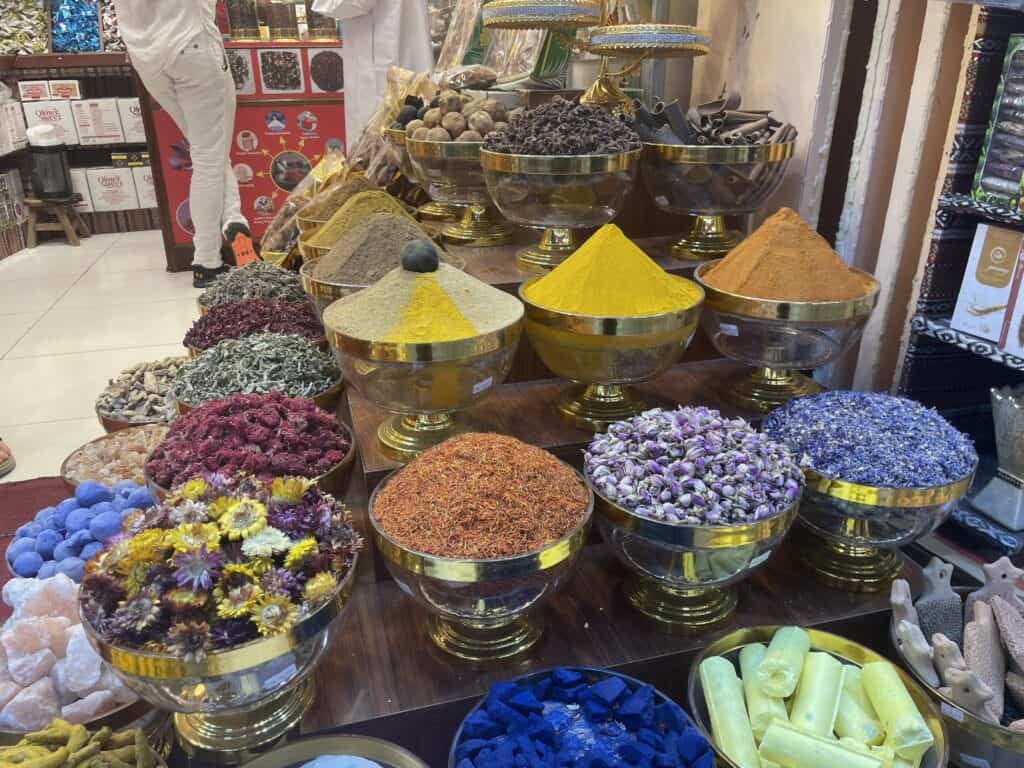
I have discovered that the secret is to focus on specific products that I want to buy such as spices and Frankincense. Although Frankincense mainly comes from Dhofar (in the south of Oman), Mutrah Souq is actually one of the best places in Oman to find a wide variety of this perfumed resin. Once I locate a shop that seems fairly quiet, I enter and start a friendly conversation with the shop keepers. It is natural to ask questions about the products and find out about their origins. I have – not yet – mastered the art of haggling so I may ask an Omani friend to bargain the prices down for me especially if I want to buy several items. But you may enjoy ‘having a try at it’
Mutrah Souq is a good place to buy local products as souvenirs. One of these products could be an Omani dagger called ‘Khanjar.’
One of the great – and hidden – joys of Mutrah Souq is taking time to discover beautiful products and their story.
In one of the alleys that is further back, I found the ‘Qazi Business’ shop called ‘Traditions’ that sells carpets, pashminas, and ‘mussar’ (Omani men’s traditional headscarf).
Fayaz, who is from Kashmir, showed me the different types of ‘mussar’ he sells – from machine-made ones (selling for 15 OMR) to top of the range ones that have been hand-woven and embroidered (selling for 250 OMR). These are works of art. He pointed out that these have all been made in Kashmir especially for Oman and other countries of the Gulf. I found it fascinating to discover that this trade has been going on for hundreds of years.
The shop also sells carpets from Kashmir and from Iran. There again, I discovered the story that connects these 2 regions. Fayaz explained that hundreds of years ago, Iranian artisans and merchants came over to Kashmir and passed on carpet-making craftsmanship to local Kashmiris.
It is in this kind of socialising that Mutrah Souq takes on its full meaning – not only as a trading place but also as a centre for exchanging information.
Next to the Retail Souq, you will find ‘the Gold Souq’ which is much smaller than its counterpart in Dubai. It is still worth taking a look at the intricate sets of golden jewellery as they too carry an important role in Omani culture – and Arabic culture in general. Golden earrings, bracelets, necklaces and rings are indeed given as an important part of the dowry to a bride. What’s more, according to Islamic principles, women are the only ones who should wear gold as men are not to wear this precious metal.
Oman was in a strategic location along the Silk Road. As a result, Muscat harbour (Mutrah) was colonised in turn by the Portuguese, the Persians, and the Ottoman Empire. It was a centre for trading goods coming from India, Iran, and China.
Mutrah Souq itself is one of the oldest markets in the Arab world. It was indeed first built in the 1820s by Sultan Said bin Sultan. Its original structure in a Y-shape can still be seen on a map although, in practice on the ground, it is a little more sketchy to locate (I’m always getting lost in the Souq but believe its part of the fun!). There also was no Corniche at the time but traders came to it either by boat, or by camel/ donkey from inland.
To protect customers and shopkeepers from the heat, it originally had palm-leaf roofing and mud-brick walls. Its narrow alleyways kept the sun out but also gave it its local name: ‘The market of darkness’ (Souq Al-Dhalam). What’s more, the shops were first built about 1 metre above ground in an attempt to protect the goods whenever it rains – the market area is in a geographically lower position, making it vulnerable to flooding.
Mutrah used to be enclosed by a wall with some houses built on the wall. At each corner, there was a tower and a gate in the south-west and one in the north-east.
The Al-Lawati community, originally from the Sindh region (actual south-east Pakistan), has been integral to the development of Mutrah Souq. They settled in the area between the late 18th and mid-19th centuries and established themselves as prominent merchants. They mainly engaged in the trade of incense, jewellery, and textiles. This contributed to the Souq’s status as a bustling marketplace. To this day, a large number of shops in the Souq belong to members of the Al-Lawati.
The community resided – and still resides – in Sur al-Lawatia, a walled quarter next to the Souq, known for its distinctive architecture and cultural heritage. You can still see the two gates that monitor who comes into the enclave.
By bus: If you are travelling around by public transport, then you need to take Bus 4 that leaves from Ruwi Bus Station. There is actually a bus stop called ‘Mutrah Souq.’ If you go to the Moovitapp or click on this link, you can plan your bus trip easily.
By car: you will need to follow directions to Mutrah. Parking is an issue in the evening but the best is to park (for free) in the car park opposite the Fish Market. You will then need to walk 5-8 minutes down the Corniche to Mutrah Souq.
If you need information about renting a car, check out the blogpost ‘Renting a Car in Oman in 2025: The Ultimate Guide.’
By taxi: To get a taxi from your accommodation, the best is to ask your hotel to call for a taxi or you can book a ride through the O’Taxi app.
The Souq mainly opens twice a day: in the mornings from 9.00 to 1.00 pm and in the afternoons from 4.00 to 10.00 pm. On Fridays, however, it is only open in the afternoon. I would recommend you visit in the evening to see the market ‘in full swing’ and also because the temperature will be more comfortable.
Certain times of year, before Eid celebrations, the market is particularly lively with local Omanis shopping for clothes and fabrics. At weekends also, Mutrah Souq gets very busy.
There are several hotels near Mutrah Souq.
No luxury hotels
Mid-range: Naseem Hotel – Small and friendly. Right on the Corniche, it offers great views on the sea and the mountains. Clean rooms with modern amenities.
Budget-friendly: Mutrah Hotel
Rental: Muttrah Souq and Sea View. One-bedroom apartment with a fantastic sea view from the balcony.
If you prefer to stay in another area of Muscat, check out my blogpost ‘Where to Stay in Muscat in 2025: A Guide to the Best Hotels & Areas – with Map.’
You may also want to visit Oman’s other famous and most traditional Souq. Read my complete guide to Nizwa Souq and its Friday Goat Market.
Christine is a Muscat-based writer, watercolourist and teacher. She's been living in Oman for 4 years and she's also lived in Jordan and Dubai. She shares resources and stories to help independent travellers plan creative trips and truly experience Middle Eastern cultures.
One Response