Nizwa Souq Guide (2026): What to See and Buy + Local Tips

29th November 2025

In this practical guide, I walk you through each section of Nizwa Souq — including the Goat Market (al-Munādāh), what to buy, when to visit, and how to navigate it respectfully — based on a visit guided by a local from Nizwa.

Nizwa Souq is one of Oman’s oldest and most important traditional markets and one of the best places to experience everyday life in the Interior region. Located in the centre of Nizwa beside Nizwa Fort, the souq is best known for its Friday morning Goat Market. But it also includes pottery from Bahla, spices, dates, silverwork, and everyday goods still used by locals today.

This in-depth visit to the Souq is a highlight of Joussour to Oman’s 7-Day Itinerary I recommend for discovering Oman and its cultural heritage. You can also check out my 4 possible itineraries in and around Nizwa.

Table of Contents

Main entrance of Nizwa Souq in Oman, showing the large wooden gate, Omani flags, and traditional fort-style architecture
The main gate of Nizwa Souq, a familiar sight in Nizwa and a reminder of the market’s long history, even though visitors enter through the smaller side doors and other gates.

What You’ll Find at Nizwa Souq (Quick Overview)

  • Pottery from Bahla (red clay lanterns, bowls, incense burners)

  • Arms market (khanjars and traditional blades)

  • East Souq (spices, frankincense, household items)

  • Vegetable souq (local produce and honey)

  • Date market and halwa shops

  • The Goat Market

Essential Information at a Glance

  • Best day: Friday morning (for the Goat Market)

  • Best time to arrive: 6:00 a.m.

  • Location: Next to Nizwa Fort, central Nizwa

  • Highlights: Goat Market (al-Munādāh), pottery, dates, spices

  • Time needed: 1.5–3 hours

  • Dress code: Modest, relaxed

Exploring Nizwa Souq with a Local

On this visit, I was shown around the souq by Amjad, a local from Nizwa. Join us as we move through the market to discover small routines and hidden gems we would never find on our own.

The Pottery Market: Bahla's Clay Tradition

A good Friday morning at Nizwa Souq starts early. When I arrived just after five, the first sound was the adhan calling people to prayer as the day slowly took shape.

Passing through one of the main gates, I reached the pottery section before the stalls had opened. Clay lanterns hung overhead, catching the early light and casting soft patterns across the floor — a quiet moment before the market fully woke up.

The red pottery sold here comes from Bahla, an oasis town about 35 minutes from Nizwa. This tradition dates back several centuries, with techniques passed down through generations of potters. Bahla pottery is recognised across Oman for its distinctive red clay and simple, functional forms.

Nizwa Souq is one of the easiest places for visitors to buy authentic Bahla pottery directly — from lanterns and bowls to incense burners — making this section a worthwhile first stop as the market comes to life.
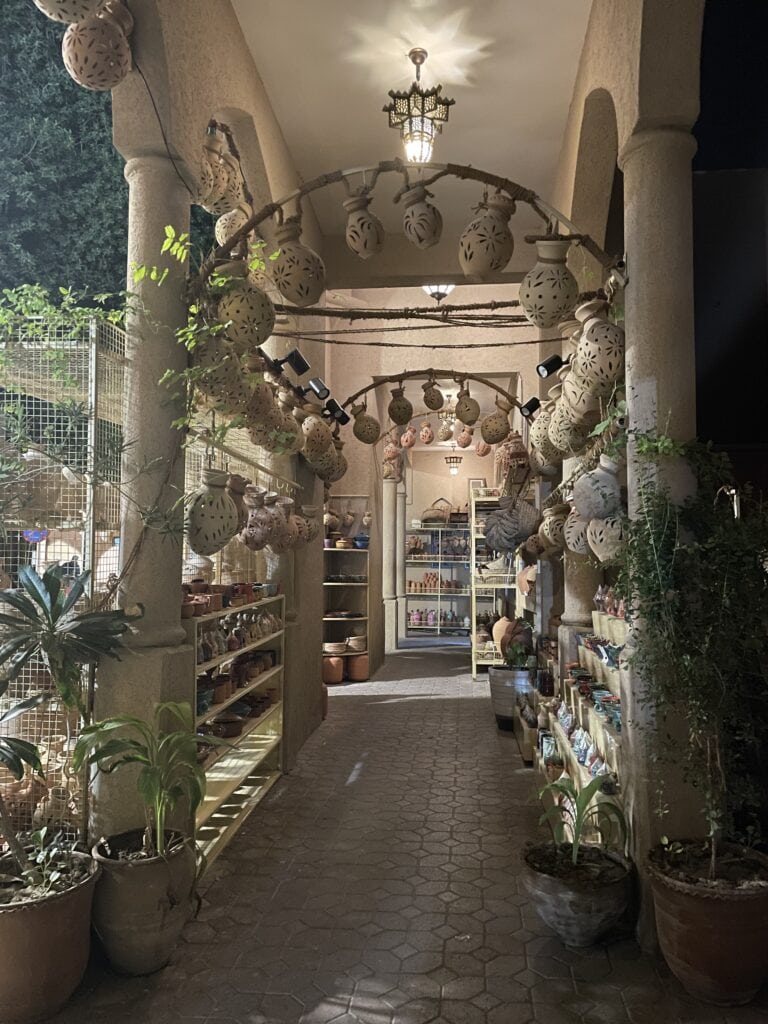
Early morning at Nizwa Souq pottery section, showing hanging clay lanterns, shelves of pottery, and soft shadows across the tiled walkway.
A distinctive part of Nizwa Souq: shelves of pottery, hanging lanterns, and shaded arches that guide you further inside.

The Corner for Old Finds & Antiques

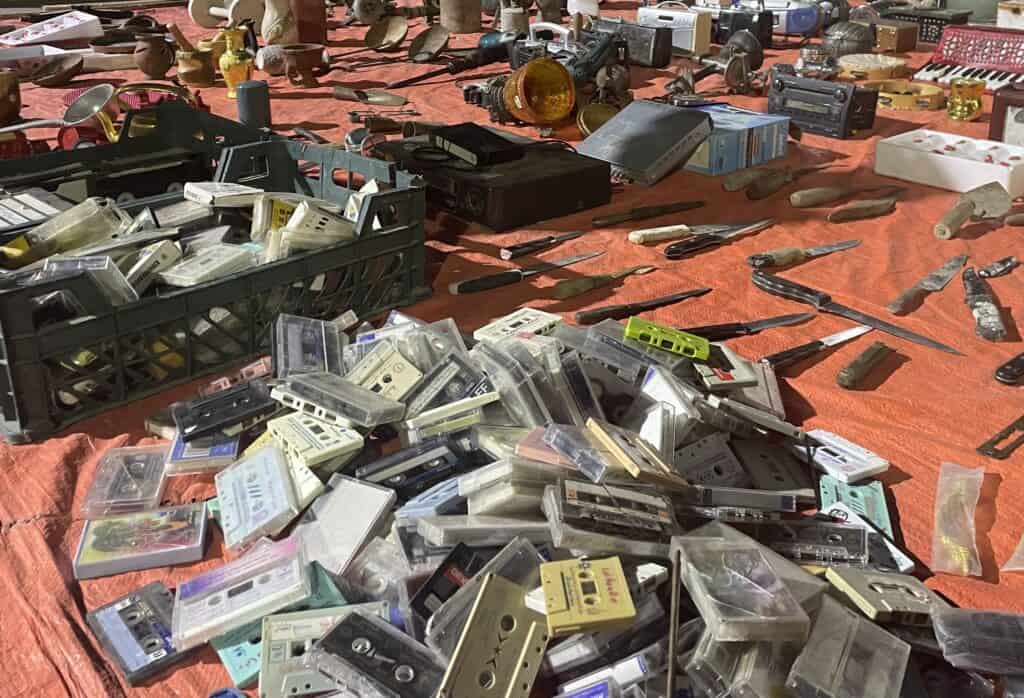
I met Amjad soon after and he suggested we begin our visit with ‘the Vintage Finds’ Corner – a spot I wouldn’t have noticed on my own. It is situated in a corner of the car park opposite the Central Main gates to the market.

Here, there are no stalls at all; sellers spread their finds on sheets laid directly on the ground. Old cassettes, brass coffee pots, worn tools, copper kitchen bowls, and the occasional antique all sit side by side.

Assortment of old cassette tapes, tools, and second-hand objects laid out on a sheet at Nizwa Souq’s outdoor market corner
A typical spread in this corner of the souq — everyday objects from past decades that reveal what once filled Omani homes and workshops.

A Local Breakfast Stop: the 'Post Office Grill'

It’s now time for breakfast — I’m actually starving! We go to a proper local stop just across from the post office. The place is officially called Mashawi Al Wadi. But locals in Nizwa know it as Mashawi Al Bareed, the “Post Office Grill.” It has been here for 35 years and is a simple cafe serving only one Omani classic, mishkak. ‘Mishkak’ is  barbecued beef on small skewers and can be eaten with salad or in a sandwich.

When we arrived it was still early, but the place filled quickly with locals stopping in before the market. It was a hearty breakfast, and it’s exactly the kind of spot worth trying if you want a quick, authentic bite (and experience!).

Exterior of Mashawi Al Wadi, a small mishkak cafe in Nizwa located opposite the post office, with a man sitting on the steps outside
Mashawi Al Wadi — known locally as the ‘Post Office Grill’ — a long-standing spot for early-morning mishkak.

While you’re in the vicinity, it’s worth hopping over to the other side of the street to see the two old letter boxes. They’re no longer in use, but are still side by side: one labelled “Arab Countries” and the other “Other Countries.”

The post office itself is still operating and sits only a few metres away, making this a small but interesting stop before heading back toward the souq.

Two old letter boxes on a wall in Nizwa, labelled ‘Arab Countries’ and ‘Other Countries’, no longer in use
The two old letter boxes near the post office — a small detail many people walk past without noticing.

The Arms Market

 From there, we wandered over to the arms market. This is a section where traditional khanjars (Omani daggers), blades, and other items are bought, sold, and repaired.

Important note: The arms market is cultural rather than tactical — these are heritage items linked to identity, craftsmanship, and tradition, not modern weaponry.

A silver Omani khanjar and belt displayed in a red box at the arms market in Nizwa Souq
A beautifully crafted Omani khanjar, one of the traditional pieces bought and sold at the arms market.
Display of Omani khanjars, rifles, and tools laid out for sale at the Nizwa Souq arms market during the Friday auction.
A glimpse of what traders bring to the Friday auction — from khanjars to old rifles, each with its own story.
A man smiling and holding a newly purchased knife at the arms market in Nizwa Souq
A buyer proudly showing a knife he just bought at the arms market.

As a foreign woman, I was aware that I was the only woman present, but it was completely acceptable for me to be there. For Omani women, however, visiting this particular area – and the souq in general – isn’t part of the cultural norm. Bedouin women, on the other hand, sometimes do, and their presence seems to be understood.

Much of the selling here is done by auction. A man, appointed to call out the bids, manages the process. It’s a space shaped mainly by men, but I recommend you walk through and observe. It will give you a unique sense of how these traditional transactions still unfold today. You might even decide you want to buy a khanjar as a souvenir!

A table displaying Omani khanjars at the arms market in Nizwa Souq, with two men seated behind them in conversation

The West Souq

The entrance to the West Souq in Nizwa market

Right near the ‘Arms Market’, we find the entrance to the West Souq. Although it was once the heart of Nizwa’s silverwork and traditional crafts, very little trade happens here today. Still, it’s worth stepping inside for one striking detail: a beautifully preserved wooden ceiling with an ingenious old ventilation system. Small angled windows sit on each side of the structure, designed to draw hot air upward and out — a simple, clever solution perfectly suited to Oman’s climate.

Traditional wooden ceiling with angled ventilation windows inside the West Souq in Nizwa, showing the old cooling system used in Omani architecture.
The beautiful wooden ceiling of the West Souq — complete with its old, cleverly designed ventilation windows.

The East Souq: Daily Essentials and Spices

After whirling round the arms market, time to pop into the East Souq.This is a part of the market dedicated to everyday essentials. Spices, dried foods, incense, and practical household items are sold here week after week, making it one of the most lived-in corners of the souq. It’s also a good place to find authentic souvenirs, including Omani coffee cups, spices, and frankincense.

A variety of spices sold in the Souq of Nizwa
It can be a great souvenir to bring back a variety of spices from Nizwa Souq
Some traditional Omani coffee cups

Before leaving the East Souq, Amjad took me to a small corner where the old market well still stands. It’s no longer in use, but he lowered the bucket to show how traders once drew water here during long mornings at the souq. A simple moment, but one that brings the history of this place quietly to life.

By the old well in a corner of the East Souq in Nizwa market
A deliberate switch to black and white: Amjad by the old well, a scene that carries a sense of history all on its own.

The Vegetable Souq

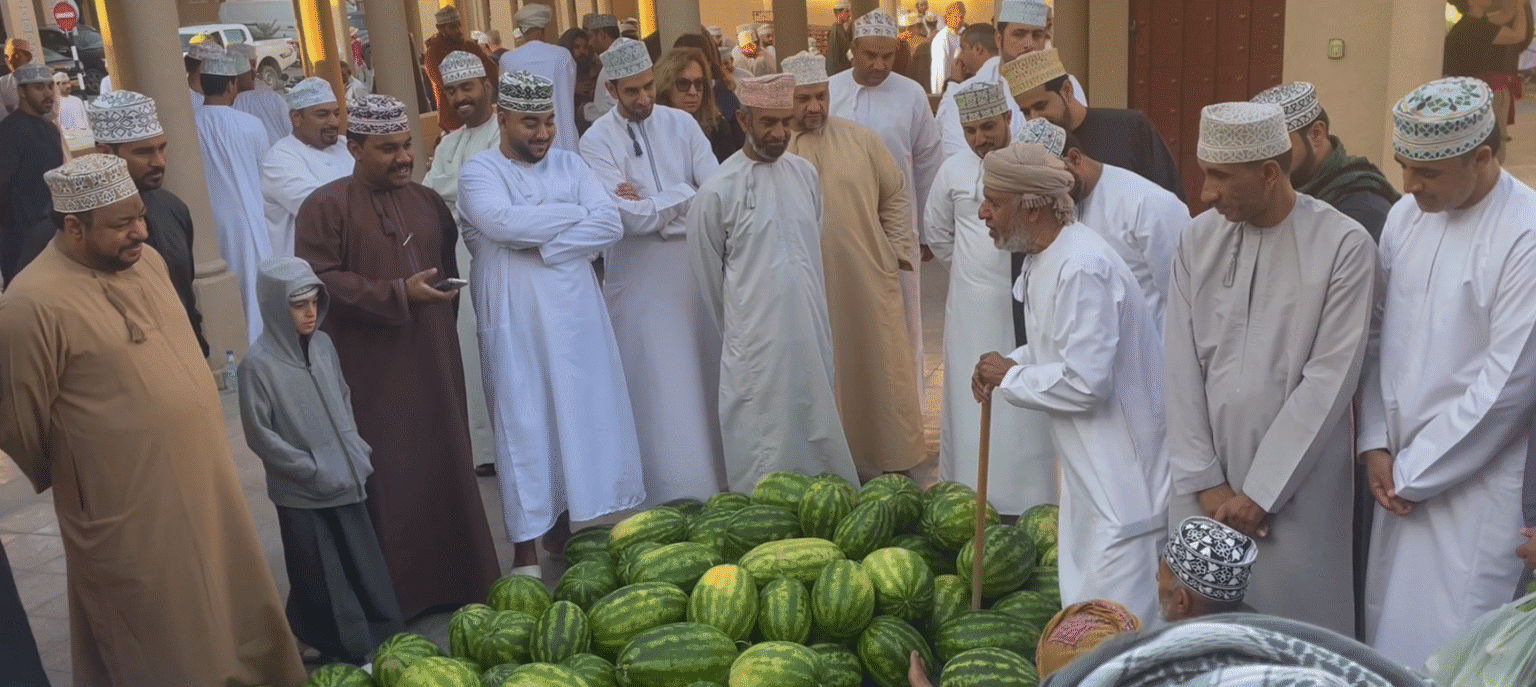
 We walked on to the vegetable souq, which was buzzing. Farmers stood over neat piles of greens and spring onions still streaked with earth, while buyers gathered tightly around the sellers, calling out their bids with cheerful determination.

Omani vendor handing a bag of fresh greens to a customer at the vegetable souq in Nizwa.
Early-morning greens being sold the traditional way — directly from the growers who bring them in at dawn.
Young boy sitting beside bundles of fresh herbs and spring onions at the Nizwa vegetable souq.
A young helper among the morning’s harvest — many families sell their produce together.
Men gathered around a pile of watermelons at Nizwa Souq in Oman during the Friday market

A little further along, I noticed a small table covered with plates of fresh honeycomb — something I had never actually seen in person before. Thick pieces were cut straight from the hive and set out as they were, still glistening in the morning light.

Fresh honeycomb pieces for sale on plates at the vegetable souq in Nizwa.
Fresh honeycomb, sold just as it comes from the hive — a treat at the souq.

Inside the Market Hall and the Date Market

After wandering through the lively vegetable souq outside — all bunches of herbs, bargains, and early morning chatter — we stepped into the indoor Market Hall.

A general view of the indoor market part of Nizwa Souq

This is where you’ll find the dates section and the halwa shops, two of the souq’s treasures and, honestly, some of the best souvenirs to take home. Omani dates come in so many varieties that you can taste your way through the country’s regions, and a beautifully wrapped box of halwa makes a thoughtful and genuinely local gift.

A display of Omani dates in large round containers with clear lids, surrounded by shelves filled with packed dates in different varieties.
A rich array of Omani dates — one of the sweetest (and easiest) souvenirs to take home.

The Goat Market (al-Munādāh): The Heart of Friday at Nizwa Souq

Quick Facts on the Goat Market
 
Local Name for Auction
al-Munādāh (المُنَادَاة)

Day: Friday morning only

Best time to arrive: 6:00–6:30 a.m.

Peak bidding: 7:00–8:30 a.m.

Location: Circular pavilion near the main souq area

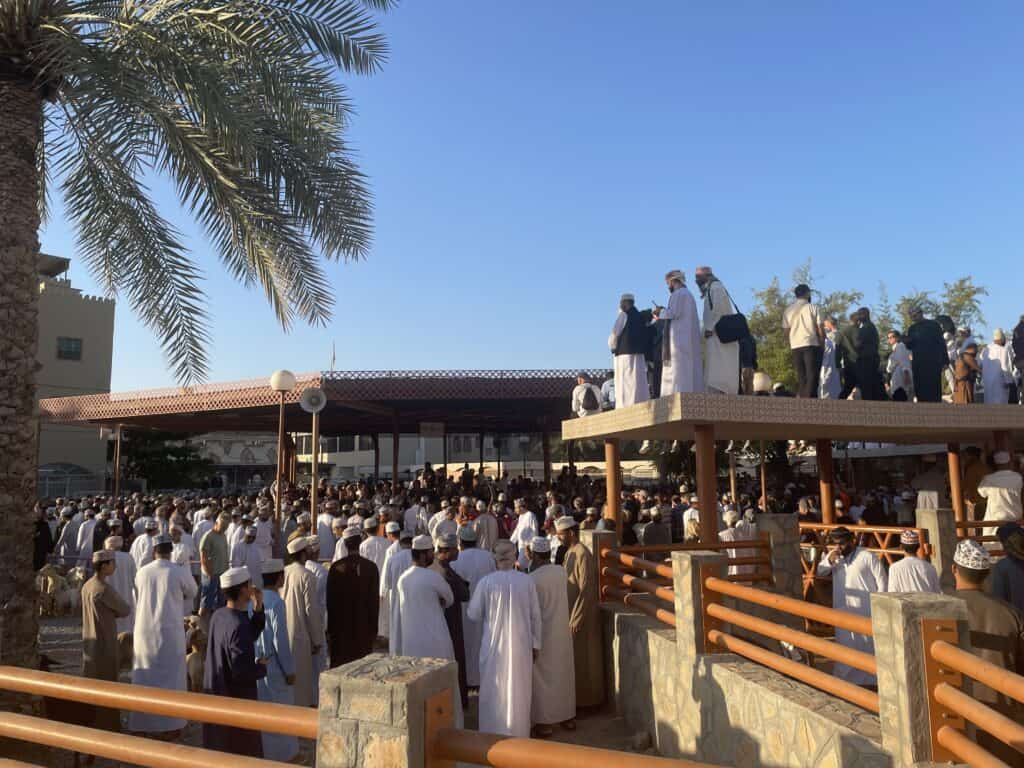
The Goat Market is the grand finale of a Friday morning at Nizwa Souq, and it truly feels like stepping into living heritage. As we reached the circular pavilion, the crowd had already thickened into a dense ring.

Sellers moved through it with goats that didn’t always want to cooperate, buyers called out their bids from every direction. Meanwhile, tourists threaded themselves into any gap they could find.

The whole space pulsed with a kind of lively, slightly chaotic energy — the kind that comes from dozens of things happening at once, all layered over a system that locals understand instinctively.

Crowds gather under a covered pavilion at the Nizwa Goat Market, with men leading goats through the ring
A lively moment at the Nizwa Goat Market, where goats are paraded through a sea of people
An Omani man leads a long-haired goat through the Nizwa Goat Market ring while seated buyers and onlookers watch closely.
A proud seller walks his goat through the ring as buyers study each animal with careful attention

The growing popularity of Nizwa’s Goat Market seems to have created a small challenge: so many visitors now come to watch that it can be surprisingly difficult to actually see the animals being paraded. You may find yourself craning your neck, slipping between shoulders, or simply listening to the rhythm of the market rather than watching it. Still, even from the edges, the atmosphere is unforgettable. I would describe it as lively, proud, and deeply rooted in Omani tradition.

A Living Tapestry: The Dishdashas and Kumas of Nizwa’s Traders (Local Dress Code)

One thing that struck me was the colours. In the Interior region of Oman, men wear a much wider palette than visitors often expect, and it gives the whole market an earthy, grounded beauty. Around the ring were dishdashas — the long, ankle-length robes worn by Omani men — in shades of sand, cream, beige, cocoa brown, olive, dusty grey, and even the occasional pale blue. 

A close-up view of Omani men wearing intricately embroidered kumas at the Nizwa Goat Market, gathered closely around the auction ring on a busy Friday morning.
The intricate embroidery of the Omani kuma — each pattern unique — stands out beautifully in the crowd at Nizwa’s Friday Goat Market.

The headwear carried just as much character. Most men wore the kuma, a traditional Omani embroidered cap with dense geometric stitching that reflects both region and personal taste. No two are exactly alike, and up close the details are extraordinary — tiny patterns, layered colours, and designs that take real skill to produce.

Inside the al-Munādāh: How the Auction Works

The auction — known locally as al-Munādāh (المُنَادَاة) — is surprisingly fluid. While there is no single, formal auctioneer, the process is managed by a manadi (caller) who acts as a facilitator, ensuring the bids are heard and the process moves quickly.

Sellers lead goats (or sheep/cows, though goats dominate) on ropes or leads, parading them around the market’s circular pavilion so buyers have a chance to see them close-up. 

As animals pass, buyers shout bids — sometimes calling out numbers, sometimes simply raising their voices — from all sides.

When a seller hears a bid he likes, he walks over to the bidder and they negotiate outside the ring. The buyers don’t just look at the animal’s size; they check the teeth for age, the coat for health, and the hooves for strength. These are the criteria a local uses to select the best livestock. Money and ownership are transferred privately — not in the middle of the parade area.

Crowds gathered around the Goat Market

As I stepped away from the Friday goat market, the energy of the morning was still buzzing around me. Nizwa Souq felt alive in every possible way. It isn’t just a market — it’s a window into real Omani life. I left with a full heart and a simple wish to return again.

WELCOME to JOUSSOUR to OMAN!

Hi! I’m Christine, a Franco-British writer and watercolourist living in Oman for the past four years. I share my first-hand experiences to help independent travellers plan an immersive and authentic trip to Oman.

Search the blog
Popular posts
Coming soon

Discover Your Unique Cultural Travel PERSONALITY

Take this quiz to get insight into which of the 12 cultural traveller archetypes you are.

Planning Your Visit to Nizwa Souq

Why Fridays Matter

Friday morning is the most important time to visit Nizwa Souq. This is when the market gathers into its fullest form. While it’s still pleasant on a weekday, Friday mornings feel different: farmers arrive early from nearby villages, families shop for the weekend, and the Goat Market brings everyone together in one place. It’s the moment when the souq functions as a true community space, not just a market.

What Time to Arrive

If you want to experience Nizwa Souq properly on a Friday, aim to arrive around 6:00 a.m. It’s early, but it completely changes the experience — cooler temperatures, easier parking, and time to move around before the crowds build.

Use the first hour to explore the quieter corners of the souq, starting with the area of old finds and antiques. The main action of the morning begins closer to 7:00 a.m., and you can plan your visit roughly like this:

  • 6:00 a.m. — Arrive at the souq and explore the antiques and vintage finds corner

  • 6:30 a.m. — Quick breakfast stop

  • Around 7:00 a.m. — Head to the Goat Market

  • From 7:30 a.m. onwards — Explore the rest of the souq, starting with the arms auction

How to Get to Nizwa Souq and Parking Information

Nizwa Souq is easy to find — it sits right next to Nizwa Fort in the centre of town, about a 90-minute drive from Muscat on a straightforward, well-signed highway.

Parking is available around the souq, but on Fridays it fills up very quickly. If you’re coming for the goat market, plan to arrive early and expect to park a little farther away, then walk in. On quieter days, you can usually find a spot close to the main entrance without any trouble.

If you are planning a longer trip, this visit is part of my recommended 7-Day Road-trip Itinerary.

Visitor Etiquette: What to Wear and What to Keep in Mind

 Nizwa Souq is relaxed, but modest clothing makes it easier to feel comfortable as you wander around. Think loose trousers, a light top with sleeves, and a scarf if you like having an extra layer. The rest is simple: move with the flow and check before photographing anyone up close. It’s an easy place to navigate and people are extremely friendly.

Shopping at Nizwa Souq: Haggling Tips and Payment Methods

Shopping at Nizwa Souq is easy and a bit of fun. Haggling is part of the experience, but keep it light — ask the price, offer a little less, and see where the conversation goes. Most sellers are friendly and used to a bit of back-and-forth, especially for handicrafts, antiques, or souvenirs.

Cash is still the simplest way to pay, although some shops in the indoor hall now accept cards. Bring small notes, smile, and enjoy the exchange — it’s all part of the souq’s charm.

Where to stay in nizwa

Budget-friendly: IHYAA Inn. central, just 300m from Nizwa Fort, with friendly staff, free parking, and very clean rooms (though some don’t have windows).

Mid-range: Intercity Hotel Nizwa. modern, newly opened, with comfortable rooms and a swimming pool to cool off in after sightseeing.

If you enjoyed this look at Nizwa’s traditional market, you might also be interested in exploring Muscat’s historic coastal market. For a complete guide to the capital’s famous souq, read my post on Mutrah Souq.

If you’re continuing your journey through the Interior, you may enjoy my guides to:

* Bahla and its Fort

* Birkat al Mouz

* 7-Day Itinerary in Oman: An Insider’s Road Trip Guide with Map   

Have you experienced the electric atmosphere of the Nizwa Goat Market or uncovered a hidden gem of your own? Share your favourite Nizwa Souq memory or essential tip in the comments below!

Frequently asked questions about Nizwa Souq

Is Nizwa Souq worth visiting?

Yes — absolutely. Nizwa Souq is one of the places in Oman where you can still feel the rhythm of a living market rather than a staged tourist experience. You can wander through pottery workshops, date stalls, and old finds, and if you come on a Friday morning, the Goat Market. It’s worth spending 2 hours or more here.

What time is the Souq open?

Nizwa Souq is open every day and generally opens early in the morning, with many sections active from around 6:00 a.m. Shops and stalls tend to follow a traditional rhythm: busy in the morning, closed between 1.00 and 4.00 p.m, and some reopening again in the early evening. If you want to experience the souq at its liveliest — especially on Fridays — it’s best to arrive well before 7:00 a.m., when the traders, farmers, and early shoppers are already moving through the market. On Fridays, the market closes around 11.30 a.m for prayers at the Mosque.

Do you need a guide to visit Nizwa Souq?

No — you don’t need a guide to visit Nizwa Souq. The market is easy to explore independently, and the different sections are clearly laid out. This guide is designed to give you all the context and practical information you need to navigate the souq confidently on your own, including what to expect in each area and how a Friday morning visit unfolds.

What should you buy in Nizwa Souq?

Nizwa Souq is one of the best places in Oman to buy meaningful, genuinely local souvenirs. You’ll find beautiful handmade pottery, Omani silver jewellery, woven baskets and palm-leaf crafts, frankincense and incense burners, and an incredible selection of dates and spices. These are all items that reflect everyday Omani life rather than tourist trinkets, and they make thoughtful gifts to take home.

Is it easy to find parking?

Parking is generally easy on weekdays, with several informal parking areas around the souq and Nizwa Fort. On Friday mornings, however, spaces fill up quickly because of the Goat Market. Arriving around 6:00 a.m. makes parking much easier; later in the morning, expect to park a little farther away and walk

Is the Souq open every day?

Yes. Nizwa Souq is open daily, but the atmosphere varies. Weekdays are quieter and more relaxed, while Friday mornings are the busiest and most interesting time to visit because of the Goat Market and weekly trade.

Picture of Author: Christine van den Hogen

Author: Christine van den Hogen

Hi, I’m Christine. I’ve lived in Oman for over four years and spent that time travelling across the country - from desert camps to remote mountain villages. Joussour to Oman is where I share practical guides and honest tips for experiencing Omani culture, nature, and daily life. This list is based entirely on places I’ve visited myself - often more than once.

Share it

5 responses

  1. Thank you for the detailed review! Besides being very informative, it was very well put and a pleasure to read.

Leave a Reply

Your email address will not be published. Required fields are marked *

This site uses Akismet to reduce spam. Learn how your comment data is processed.

Recommended Reads